High aggressiveness
Writes features quickly, ships quickly, and spends minimal time on tests and deep stabilization.
The term agent aggressiveness describes release tempo and acceptable risk tolerance. One agent ships features quickly, rolls them out quickly, and calmly accepts that something may break. Another ships less in the same week, but formalizes invariants, adds tests, checks edge cases, and builds the system so it behaves reliably over time.
When people talk about AI agents, they usually discuss code quality, autonomy, or how many tasks the agent can close without a human. But in product development this is not the main question. In practice it is much more important to understand at what pace the agent delivers changes to production and what price the team is ready to pay for that pace.
One mode is closer to a startup: build fast, ship fast, if it breaks - we will fix it. Another is closer to big tech: the agent moves slower on features, but carefully describes invariants, writes many tests, checks edge cases, and builds the system so it does not collapse on the next turn.
That is exactly the difference we call agent aggressiveness. The term captures release-cycle speed and the acceptable level of engineering risk.
By agent aggressiveness we mean how fast it moves the product toward release and how willingly it trades a margin of reliability for speed. The higher the aggressiveness, the faster the agent ships new features, the less time it spends formalizing invariants, and the more calmly it treats the fact that some problems will only be caught after release.
Writes features quickly, ships quickly, and spends minimal time on tests and deep stabilization.
Moves slower, but invests in tests, invariants, edge cases, and system stability.
Speed matters more than reliability. Errors are acceptable if they do not kill the hypothesis test itself.
Reliability matters more than speed. Better slower, but predictable and without expensive breakage.
An aggressive agent is needed where the team's task is to move through new features and releases as fast as possible. It will not spend weeks closing every theoretical risk. It will rather assemble a working module quickly, carry the scenario to release, and let the market show whether it was worth the effort at all.
That is startup logic: better to release five hypotheses quickly and kill four than to spend a month polishing one perfectly. Here it is acceptable that something breaks after release if the cost of that break is lower than the cost of moving slowly.
A weakly aggressive agent behaves differently. It may complete only one or two modules in the same week, but approach them the way mature engineering environments do: write down invariants, cover code with tests, walk through edge cases, remove fragile spots, and make the system stable.
This mode is slower in apparent release speed, but it is needed where an error is too expensive. In payments, security, critical user flows, loaded systems, or any place where 'it broke and whatever' actually turns into a loss of money, users, and trust.
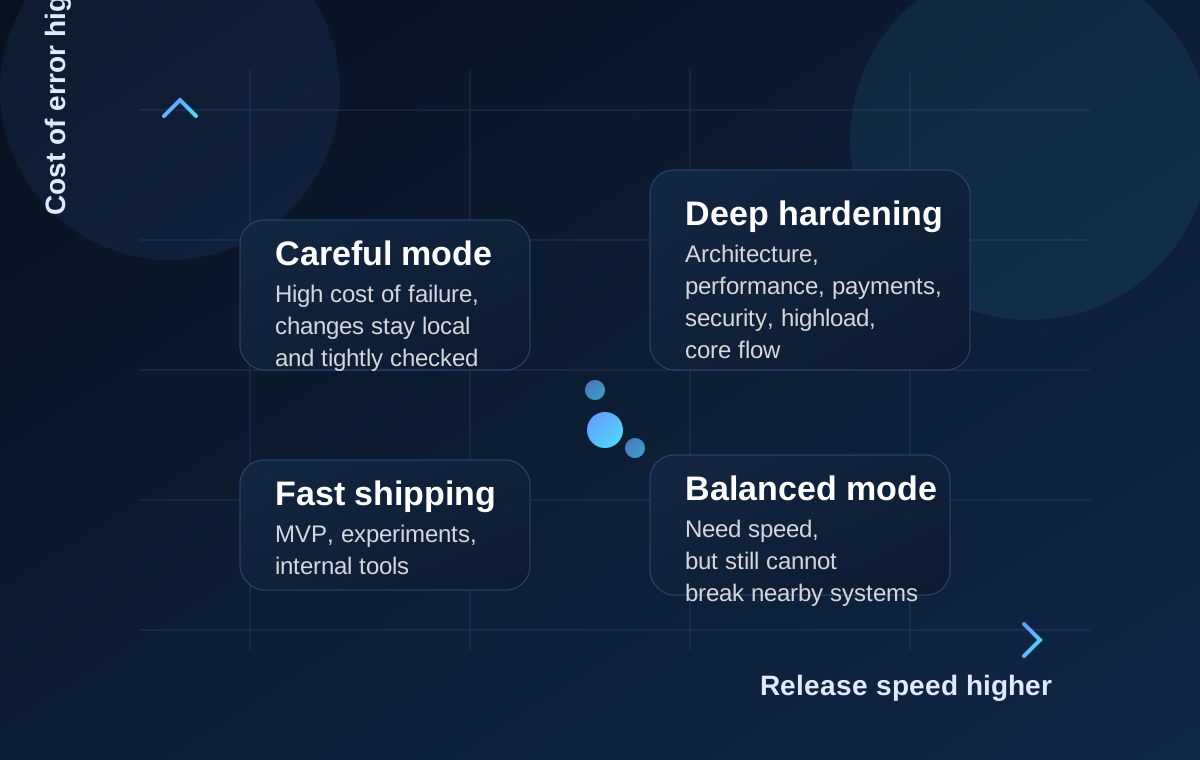
The practical rule is simple: the cheaper the error and the more important speed is, the higher you can raise aggressiveness. And conversely: the more expensive the error and the longer the function's life horizon, the less aggressive the agent should be.
| Context | What matters more | Cost of breakage | Agent mode |
|---|---|---|---|
| A new MVP or hypothesis test | Speed to market | Usually limited | High aggressiveness |
| Fast product experiments | Release frequency | Low or moderate | High or medium aggressiveness |
| Internal modules with accumulating logic | Balance between speed and stability | Moderate | Medium aggressiveness |
| Core flows, payments, security, high load | Reliability and predictability | High or very high | Low aggressiveness |
The main value of the term is that it gives the team a normal language for steering the agent. Instead of the abstract 'do it well', you get a concrete framing: do we need to ship fast right now or do we need to almost never break.
So the problem is almost never that the agent is 'too slow' or 'too bold' by itself. The problem is that it is given the wrong aggressiveness level for the specific task and the specific cost of error.
Agent aggressiveness is release speed multiplied by acceptable risk. A highly aggressive agent is closer to startup logic: build fast, roll out fast, learn fast from the consequences. A low-aggressiveness agent is closer to big-tech logic: move slower, but build the system so it can survive load, edges, and long-term operation.
This is not a debate about which mode is 'correct'. The correct mode is the one that matches the stage of the product. Some teams need an agent that ships today. Others need an agent that will not let that release break tomorrow.